How it works
Vehicle-to-Grid (V2G) turns your EV into a battery-on-wheels. Your car doesn’t just draw electricity from the grid—it can supply it back when prices are high or the grid needs support. This two-way energy flow benefits both you (through lower energy costs) and the grid (through increased flexibility).
Bidirectional Charging
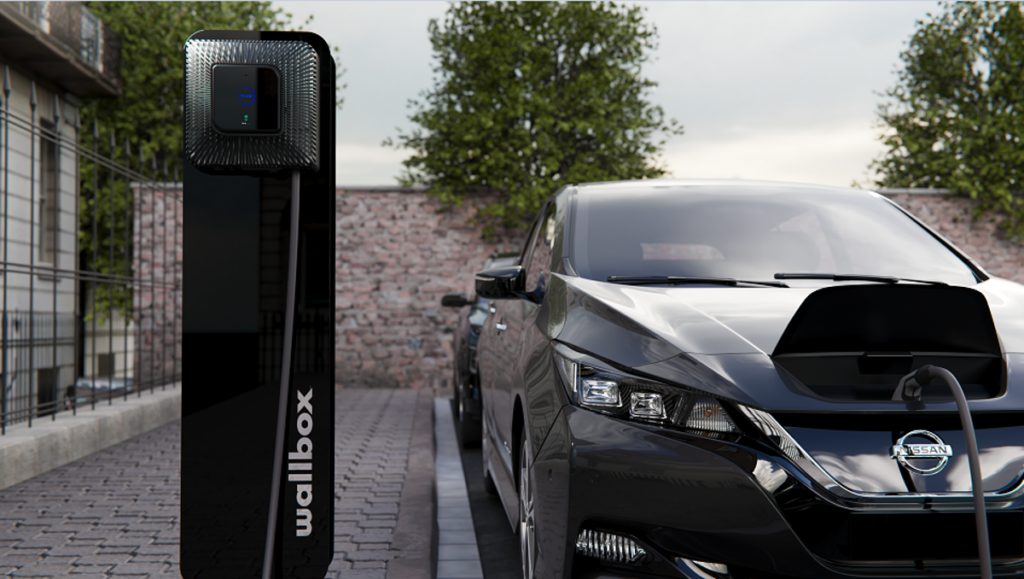
V2G requires bidirectional charging: the ability to both charge and discharge your EV battery through the same connection. This is made possible through specialized chargers and communication protocols that manage the energy flow safely and efficiently.
Two Generations of V2G
CHAdeMO: The First Wave Early V2G systems use the CHAdeMO protocol, proven reliable in vehicles like the Nissan Leaf. It works well, but isn’t the future—most new EVs use the CCS connector instead.
ISO 15118-20: The Next Generation Modern V2G uses CCS2 connectors with the ISO 15118-20 (Lite) protocol. This enables bidirectional charging with better security, higher power levels, and smarter energy management.
The Interoperability Challenge
Currently, most CCS2 V2G systems are closed: one car brand works with one charger brand. This “one-on-one” approach limits your choices and slows adoption. The industry is moving toward “any-on-any” compatibility: – Any compatible EV should work with any compatible bidirectional charger – The European Commission, IEA, and national governments are pushing for open standards – Industry bodies like CharIN, ElaadNL, and the Open Charge Alliance are developing certification programs
V2G Liberty’s Approach
V2G Liberty supports both generations:
- CHAdeMO: Works now (Nissan Leaf, older EVs)
- CCS2 ISO 15118-20: Future-ready (VW ID-series, Skoda, Cupra, expanding)
Our software is charger-agnostic and energy supplier-independent — it works with any compatible hardware and any dynamic electricity contract. As the industry moves toward true any-on-any compatibility, V2G Liberty is ready.
The goal: Your car, your charger, your energy supplier—your choice.
Architecture
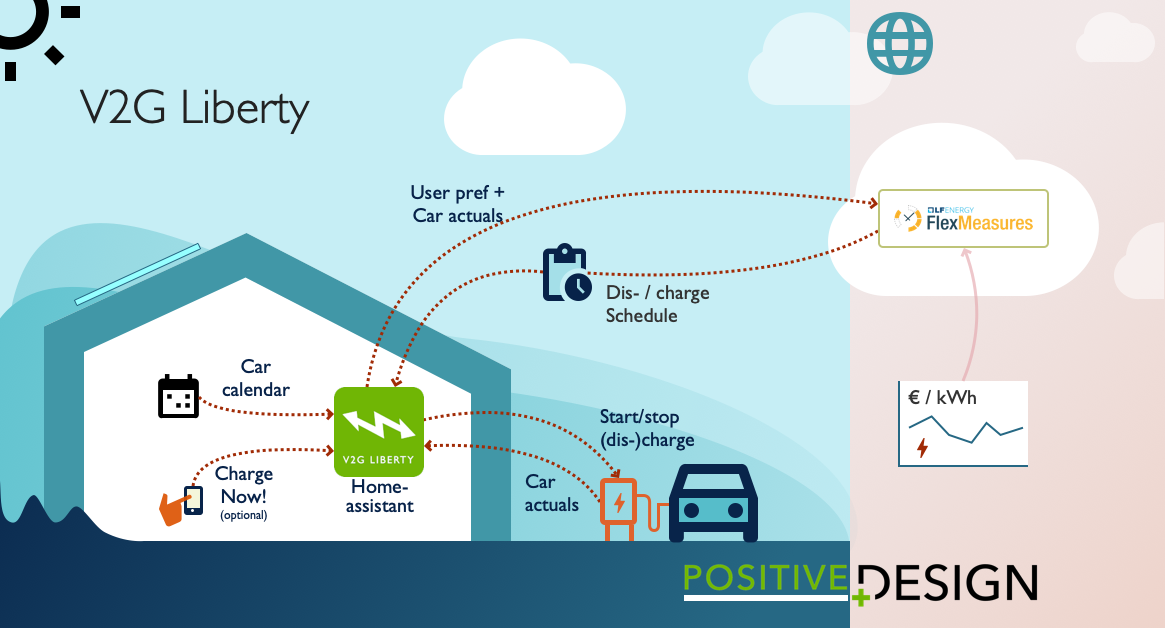
V2G Liberty uses Home Assistant, an open-source home automation platform, as a basis.
The smart charging schedules are generated by FlexMeasures, also open-source cloud software that optimises the schedules for maximum financial benefit based on dynamic customer pricing.
The app is linked to your calendar, so the battery is fully charged when a longer ride arrives. This can be a Google, iCloud, NextCloud etc. calendar or a build in Home Assistant calendar.
Configuration options
V2G Liberty is highly customisable and offers the user the ability to set up, among other things:
- Battery health limits (a minimum and maximum charge level)
- Your own auto-booking calendar (for example, iCloud, Google, NextCloud or a local Home Assistant calendar)
- The capacity of the car battery
- A pre-configured list of energy suppliers, such as Tibber, ANWB Energie, Greenchoice, Octopus (UK), Amber (Australia) or a generic supplier.
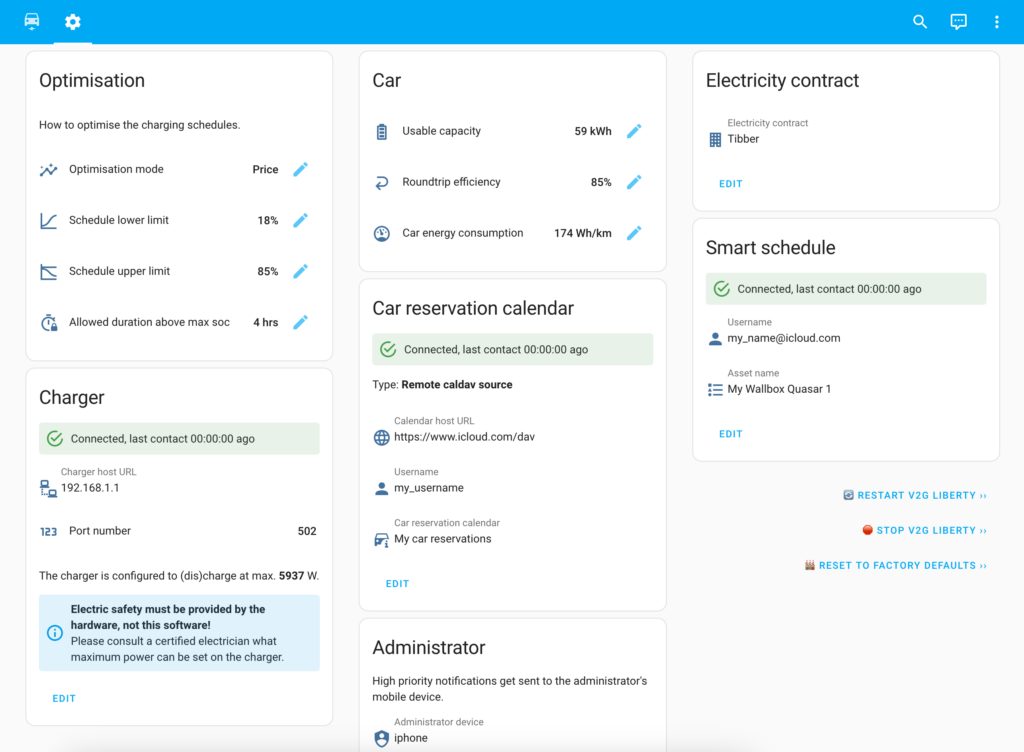
All settings are done through a convenient step-by-step guided process, which explains what and why certain settings are important and provides feedback on progress, such as connection status.
The settings page also displays the system status of the key components of the configuration.